
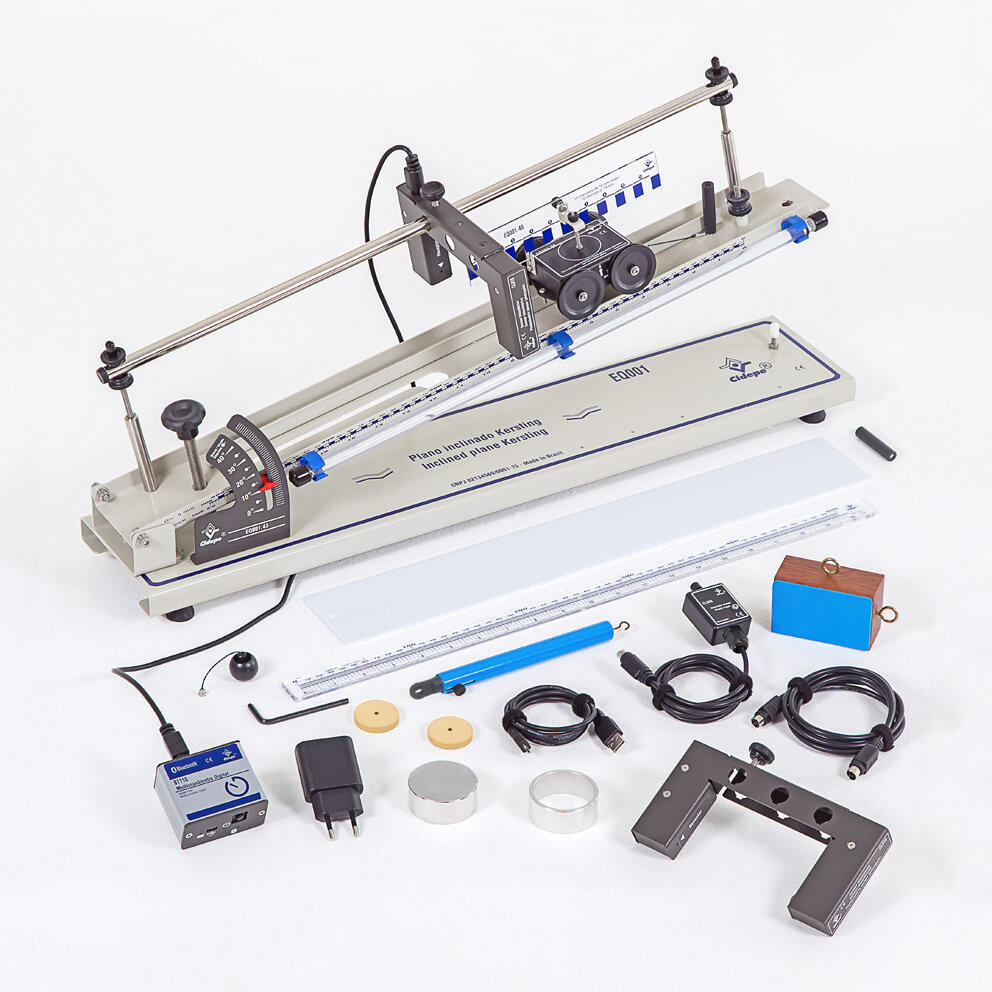
Intended for experimental study, physics laboratory work, and conducting physics experiments on: Physics. Kinematics. Reference frame, position, motion, and trajectory. What is meant by a moving object. Trajectory and displacement. The difference between displacement and distance traveled. The Cartesian reference system in the plane, orthogonal Cartesian plane. The coordinates of any point on the plane containing the orthogonal Cartesian system. Differences between scalar and vector quantities. What are the characteristics of uniform rectilinear motion (MRU)? The meeting of two moving objects in MRU with opposite directions, on the same trajectory. Uniformly accelerated rectilinear motion (MRUV) and its characteristics. Dynamics. Friction forces and Newton's first law of motion. Friction forces between surfaces of different natures that are in contact. The friction force, the apparent area, and the real area of contact of the surfaces. The kinetic friction force. The determination of the coefficients of static, kinetic, and sliding friction on an inclined plane. The coefficient of kinetic sliding friction as a function of the tangent of the angle of inclination. The coefficient of kinetic sliding friction of a body on an inclined plane. The effect of lubricants on the coefficients of static and kinetic sliding friction. Static Mechanics. The equilibrium conditions of a moving object on an inclined plane. The weight force of a body is directly proportional to its mass. The equilibrium of a material body under the action of coplanar forces. Measuring and calculating forces. Diagram of coplanar forces, forces that are in the same plane. The equilibrant forces on the x and y axes. Determining the relative percentage error. The driving force, the resisting force, and the mechanical advantage of the inclined plane, a simple machine. Measuring the weights of different masses. The resisting force and the driving force. The driving force acting on a body on an inclined plane depends on the slope of the ramp. Measuring driving forces for different slope inclinations. The inclined plane is a simple machine. Determining the mechanical advantage of the inclined plane. Conservation of mechanical energy. Conservation of mechanical energy, moment of inertia. Center of mass. Determining the height difference between two points on the ramp. Measuring the translational velocity of the hollow cylinder at the endpoint. The translational kinetic energies of the cylinders at the points of interest. The gravitational potential energies of the cylinders at the points of interest. Observing the translational and rotational movements of the cylinders rolling down the ramp. The moment of inertia. The moment of inertia of the solid cylinder. The angular velocity. The rotational kinetic energies of the cylinders at the points of interest. The conservation of mechanical energy. Comparing the initial mechanical energy with the final mechanical energy, etc.
Physics, solid mechanics, kinematics, statics, dynamics, conservation of mechanical energy. STHEAM Education. STEAM Education. CTEAM Education.