
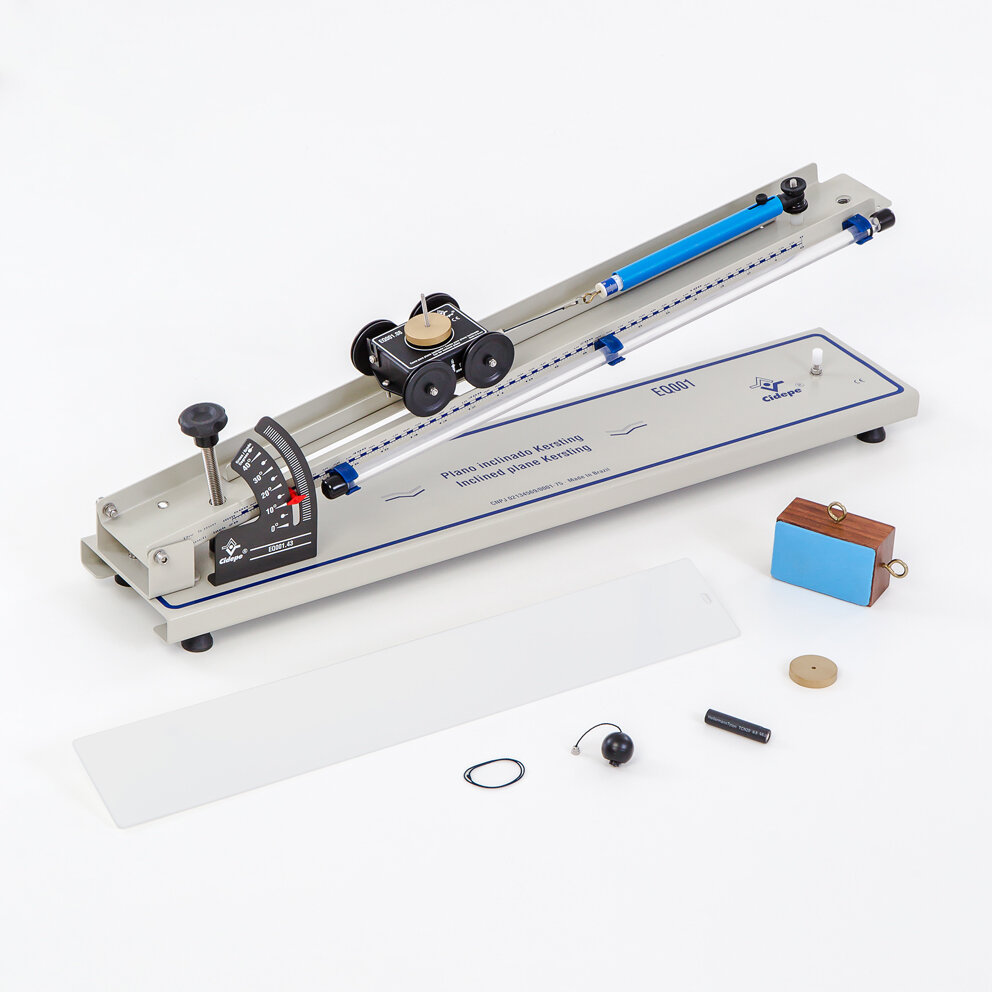
Intended for experimental study, physics laboratory and conducting physics experiments on: Physics. Mechanics of solids. Kinematics. Reference frame, position, motion and trajectory. The moving object. The trajectory and displacement. The difference between displacement and distance traveled. The Cartesian reference system in the plane, Cartesian plane. Scalar quantity. Vector quantity. The MRU and its characteristics. What is uniform rectilinear motion (MRU). The meeting of two moving objects in MRU with opposite directions. Progressive uniform rectilinear motion (MRU). Progressive (moving object moving away from the origin). Retrograde (moving object approaching the origin). Solving the meeting point by superimposing graphs. Percentage relative error. Dynamics. Friction forces and Newton's first law of motion. Static friction force. The coefficient of static friction. Friction versus Newton's first law of motion. Kinetic friction force. Determining the coefficients of static and kinetic sliding friction on an inclined plane. The coefficient of kinetic sliding friction as a function of the tangent of the angle of inclination. The coefficient of kinetic sliding friction for a metallic test specimen. The effect of lubricants on the coefficients of static and kinetic sliding friction. Statics. Driving force, resisting force, and mechanical advantage of the inclined plane, a simple machine. Measuring weights of masses. The resisting force. The driving force. The driving force acting on a body on an inclined plane depends on the slope of the ramp. Measuring driving forces for different slope inclinations. The inclined plane is a simple machine. Determining the mechanical advantage of the inclined plane. The equilibrium conditions of a moving object on an inclined plane. Measuring weights of masses. The weight force of a body is directly proportional to its mass. The equilibrium of a material body (point body) under the action of coplanar forces. Measuring and calculating forces. Diagram of coplanar forces. The equilibrant forces on the x and y axes. The condition for a material body (point body) to be in equilibrium is based on Newton's first law. The value of the driving force depends on the angle of inclination, the mass involved, and the gravitational acceleration. How to calculate the relative percentage error, etc.
Note: Time interval measurement instrument not included.
Physics, mechanics of solids, kinematics, dynamics and statics.