
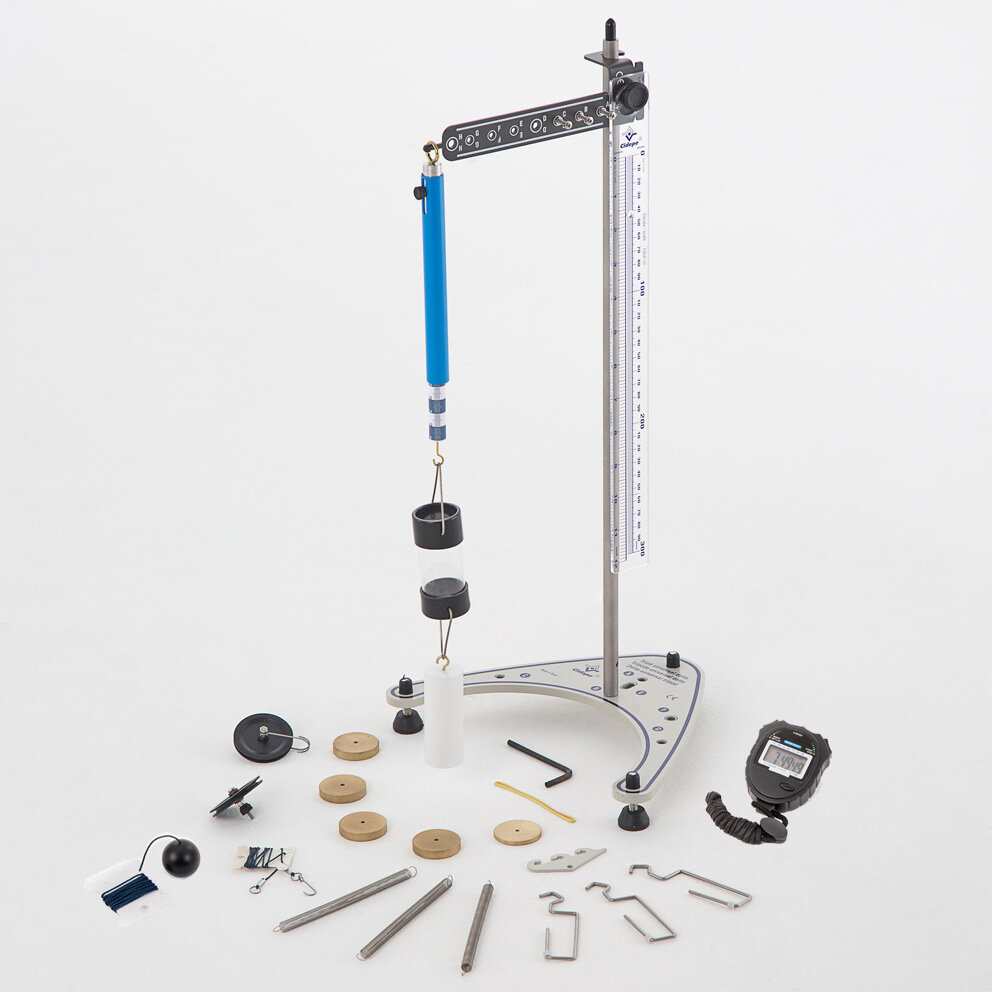
Intended for experimental study, physics laboratory and carrying out physics experiments on: Dynamics. A simple machine called a fixed pulley. A simple machine called a movable pulley. The force applied to a spring and the elongation it undergoes. Building table and graph. Measuring mass weights. The P versus m Graph. The mechanical advantage of the movable pulley. The operation of the dynamometer, the calibration of a rubber ring and a helical spring. Difference between applied force and restoring force. The helical spring and Hookes law. Energy Conservation. Work and energy in a mass and helical spring system. The energy exchanges that occur in an oscillating mass-spring system. The work done by a force acting on a body and causing a displacement of that body. Elastic potential energy and the work done by the spring. The principle of conservation of energy and kinetic energy. Hydrostatic. Buoyancy, a vertical force directed from bottom to top. Difference thrust meter. Archimedes principle. Checking the thrust action. Determining the value of thrust. The buoyant force acting on a body submerged in a fluid is equal to the weight of the volume of fluid displaced by the body. Wave. The simple pendulum. The period of oscillation of a simple pendulum. What happens to the period when the length of the pendulum is changed. Dynamic determination of K of a helical spring, mass oscillator and spring. The period, frequency and amplitude of a movement of a mass and spring oscillator. The MHS in a mass system and oscillating helical spring, etc.
Physics, dynamics, conservation of energy, hydrostatics, wave phenomena.