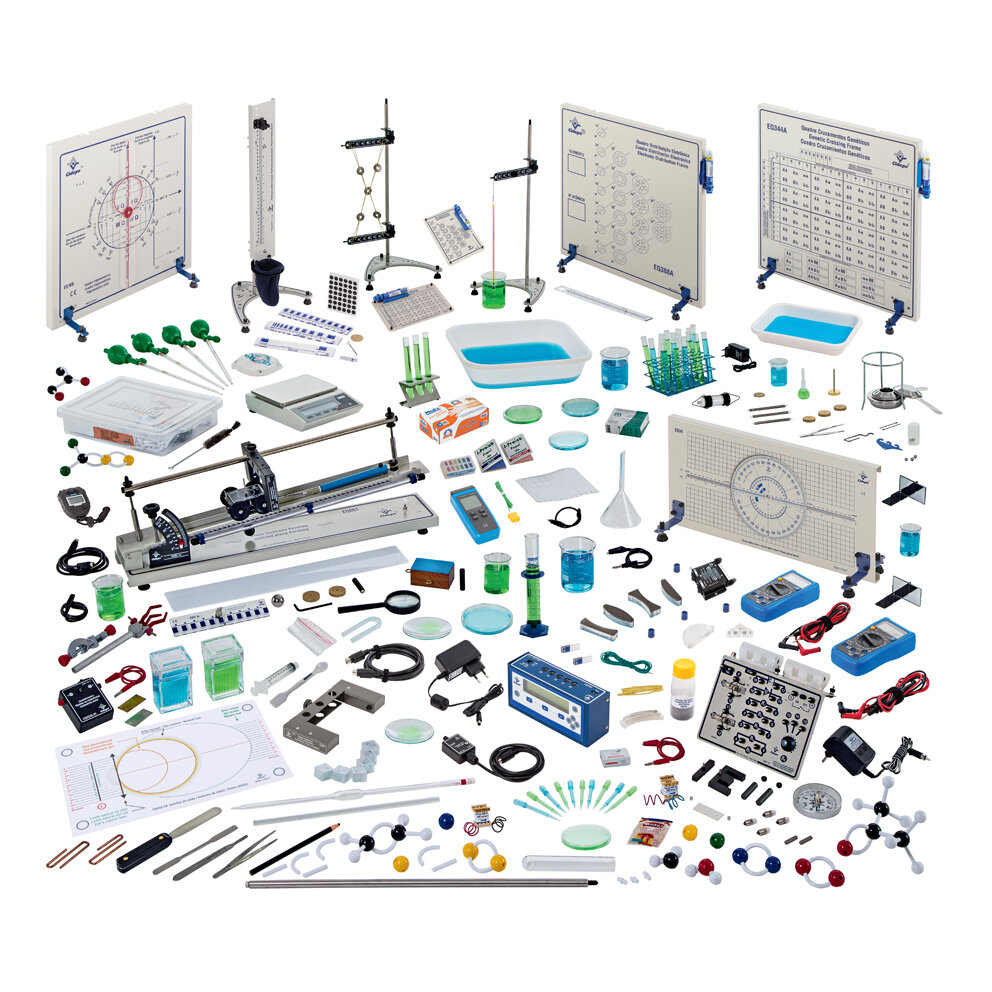
FQBM Multidisciplinary Master Set
EQ304C
Function
Intended for study, multidisciplinary laboratory, multidisciplinary experiments on uniform rectilinear motion (MRU), uniformly accelerated rectilinear motion (MRUV), simple harmonic motion (MSH), free fall, work, energy, conservation of energy, friction, equilibrium, Hooke's law, Archimedes' principle, heat, temperature, light, mirror, reflection, refraction, prism, resistor combinations, Ohm's law, non-ohmic resistor, mixed circuits, electrical power, AC, RC and DC circuits, Kirchhoff's laws, magnetic field, electromagnet, transformers, electromagnetism, uncertainties, properties of materials, density, physical states of water, mixtures, properties of substances, acids and bases, chemical kinetics, electrochemistry, Daniell cell, atomic structure, organic functions, soils, water, mold, fungi, bacteria, seeds, flower, cells, enzymes, vision, lenses, area, external and internal volume, cube, prism, polygon, perimeter, trigonometry, degree, radian, quadrants, sine, cosine, tangent, circle trigonometric, linear function, slope, quadratic function, etc.
Areas of Knowledge
Physics, chemistry, biology and mathematics, motion, variations and conservation, heat, environment and energy uses, image, electrical equipment, chemistry, recognition and characterization of chemical transformations, constitution of matter, chemistry and lithosphere, identity of living beings, interaction between living beings, diversity of life, quality of life, algebra, functions, geometry, trigonometry, population biology, Mendelian genetics, heredity, properties and characteristics of atoms, periodic table.
Main Experiments
-
Reference frame, position, movement, and trajectory. — 1032.001
-
What are the URM characteristics? multi-chronometer — 1032.005B1
-
The meeting of two moving objects in URM with opposite directions, on the same trajectory, multi-chronometer — 1032.005C1
-
The VURM and its characteristics, multi-chronometer — 1032.006_D
-
The free-fall motion with a test body of 10 equal intervals. — 1032.010K1
-
The principle of conservation of mechanical energy in a falling cylinder. — 1032.010K3_1
-
Frictional forces and Newton's first law of motion. — 1032.046
-
The equilibrium conditions of a body on an inclined plane. — 1032.043
-
Determining the coefficients of static, kinetic, and sliding friction on an inclined plane. — 1032.048
-
Work and energy in a mass-helical spring system. — 1032.056B
-
The helical spring and Hooke's law. — 1032.052B
-
Buoyancy, a vertical force, directed upwards. — 1042.028B
-
Simple harmonic motion SHM in a system of oscillating helical mass and spring. — 1072.008B
-
Dynamic determination of the K of a helical spring, mass-spring oscillator. — 1032.012B
-
— 1052.004C2_1
-
— 1052.004C2_2T
-
The principles of geometrical optics — 1062.003E1
-
— 1062.003E2_2
-
— 1062.003E4_2
-
— 1062.003E5_2
-
The spherical lenses and its main characteristics — 1062.003E6
-
The refraction in a 90 degree optical prism — 1062.003E8
-
The image formed in a plane mirror and its characteristics. — 1062.004D
-
The number of images formed between two plane mirrors at an angle to each other. — 1062.004E
-
The color code used to characterize a resistor and its electrical resistance. — 1082.048
-
Series and parallel lamp connections. — 1082.044A_1
-
Ohm's law. — 1082.056A_1
-
Identifying a non-ohmic resistor. — 1082.064A_1
-
Resistor combinations in series, parallel, and mixed configurations. — 1082.076A_1
-
The potentiometer is a variable resistor. — 1082.084_1
-
The resistance offered by a diode. — 1082.088A_1
-
Measurements in mixed circuits and electrical power. — 1082.092A_1
-
Measurement of the difference in electrical voltages between two points in an AC circuit. — 1082.129
-
Measurements of electric current intensity between two points in an AC circuit. — 1082.130
-
The series RC circuit, in direct current. — 1082.131
-
Kirchhoff's loop law and Kirchhoff's knot law. — 1082.076B
-
The measurement of the potential difference voltage between two points in a DC circuit. — 1082.053_B1
-
The measurement of electric current intensity in DC circuits. — 1082.053_B2
-
The lines of force and the magnetic field of a magnet, magnetism. — 1082.120A
-
The transformer, step-down and step-up converter. — 1082.176_4
-
Permanent magnets, temporary magnets, and electromagnets. — 1082.140A1
-
Electromagnetic phenomena and electromagnetic induction. — 1082.128B
-
— 1032.003_B
-
Comparing different volume measurement scales. — 1032.003_B_1
-
— 1042.036_11
-
— 1042.036_31
-
— 1052.008_A3A
-
— 1212.012_1
-
How can we relate the properties of substances through electrical conductivity? — 1222.012_A_1
-
The electronic configuration of chemical elements, using the table. — 1232.035Q
-
The electronic configuration of chemical elements, using the table. — 1232.035T
-
How do acids and bases behave in relation to different indicators? — 1252.024_1
-
The concentration factor. — 1282.002
-
Electrochemistry, the Daniell cell. — 1082.039
-
Construction of three-dimensional organic structures. — 1302.001
-
Organic elemental analysis - identification of oxygen — 1302.006A
-
Alcohol, water absorption, color change. — 1302.016A
-
How to identify humus-rich, sandy, and clayey soils? — 0001.050
-
What does your water hide? — 0001.362A
-
The mold decomposes organic matter — 0001.250
-
How do yeast-like fungi develop in salt and sugar? — 0001.256
-
Macroscopic fungus — 0001.260A
-
Identifying some seeds - PLANTS — 0001.040
-
What are the structures of a flower like? — 0001.180
-
How does catalase work inside plant cells? — 0003.015
-
Is it possible to observe the action of enzymes? — 0003.017
-
How do you test the pH of different substances? — 0003.019
-
Vision defects, correction of hyperopia and myopia with lenses — 1062.003E7
-
— 1505.121
-
Genetic crosses, using a Punnett square. — 1505.121T
-
What are the characteristics of the graph of a linear function? Positive slope. — 1400.000
-
What are the characteristics of the graph of a linear function? Negative slope. — 1400.000A
-
What are the characteristics of a quadratic function? — 1400.102
-
Degrees, radians, quadrants and their conversions, with panel. — 1072.006_A
-
The sine function in the trigonometric circle, a sinusoidal function, with a panel. — 1072.006_B
-
The cosine function on the trigonometric circle, with a panel. — 1072.006_C
-
The tangent in the trigonometric circle, with panel. — 1072.006_D
-
The fundamental trigonometric relationship in the trigonometric circle, with panel. — 1072.006_E
-
How to handle a scalpel. — 1998.302
-
— 1032.012_3JM
-
Volume measurements using different instruments and their measurement uncertainties. — 1032.003_C_2A
-
— 0001.100B
-
Titrimetry with color change. — 1272.002A1