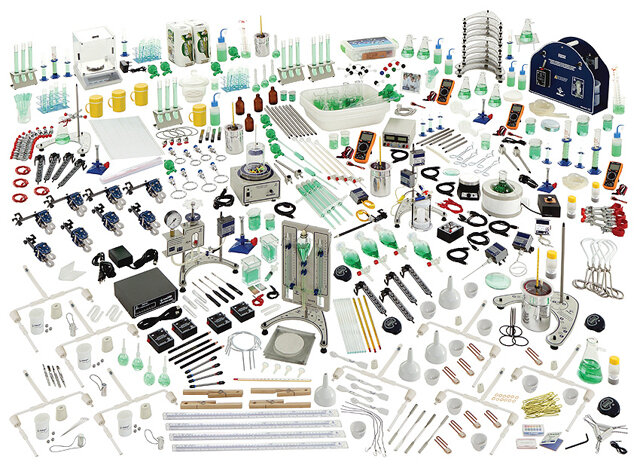
Chemistry set with sensors and interface, for 4 groups
EQ351
Areas of Knowledge
Chemistry, chemical equilibrium, thermochemistry, kinetics, electrolysis, solutions, carbon and its compounds, organic functions.
Main Experiments
-
Laboratory reports and notebooks FQB. — 1201.003C
-
— 1995.999A
-
How to use the insufflation bulb — 1201.004
-
Comparing different volume measurement scales. — 1032.003_B_1
-
— 1032.003_C_2
-
— 1032.003_B
-
How are the temperatures of a Bunsen burner measured? — 1201.011
-
How to identify homogenous and heterogeneous systems — 1201.010
-
How do you determine the density of a liquid using a pycnometer? — 1042.036_1
-
The determination of the density of a liquid by an aerometer — 1042.036_2
-
How do you determine the density of a solid? — 1042.036_3
-
— 1201.014_B_1
-
— 1201.014_B_2
-
Lavoisier and Proust's law, in a reaction chamber. — 1232.015
-
— 1212.012_1
-
— 1212.012_2
-
— 1212.012_3B
-
How to separate heterogeneous mixtures using decantation — 1212.012_4
-
— 1212.014_A_1
-
— 1212.014_B_2
-
How can we relate the properties of substances through electrical conductivity? — 1222.012_A_1
-
Chemical bonding – How to describe the properties of substances through solubility in polar and nonpolar solvents. Part II of II — 1222.012_2
-
How to identify the occurrence of a chemical reaction — 1232.002
-
Classification of inorganic reactions - How does the decomposition reaction analysis of sodium carbonate occur? Part I of IV — 1232.026_1
-
Classification of inorganic reactions - How does the reaction of synthesis of ammonium chloride occur? Part II of IV — 1232.026_2
-
How does the hydrogen displacement reaction, a single replacement reaction, occur? — 1232.027_1
-
How does a double displacement reaction occur? — 1232.027_2
-
Classification of inorganic reactions - How does the reaction of oxidation-reduction redox occur? — 1232.028
-
How do acids and bases behave in relation to different indicators? — 1252.024_1
-
Inorganic chemical functions – How to analyze the different chemical properties of acids. Part II of II — 1252.024_2
-
Inorganic chemical functions – How to identify the nature of an oxide. Part I of III — 1252.022_1
-
How do you identify the acidic nature of an oxide? — 1252.022_2
-
Inorganic chemical functions – How to obtain a basic oxide. Part III of III — 1252.022_3
-
Inorganic chemical functions – How to obtain salts — 1252.026
-
pH determination and limitations of indicator paper — 1272.008
-
Titration — 1272.002A
-
The concentration of acid in a fruit — 1272.004A
-
The water equivalent and heat capacity of a calorimeter. — 1052.027A
-
Determining the specific heat capacity of a solid. — 1052.003I
-
Endothermic reaction of copper sulfate with water. — 1232.016A
-
Exothermic chemical reaction of copper nitrate — 1232.016B
-
The heat of neutralization. — 1292.002A
-
Electrochemistry, the Daniell cell. — 1082.039
-
Electrolytes, second-class conductors. — 1242.002
-
The decomposition of water through electrolysis, variable source. — 1242.004_A
-
The concentration factor. — 1282.002
-
The temperature factor — 1282.004
-
The catalyst factor. — 1282.006
-
Study of gases - Isothermal transformation, Boyle-Mariotte´s Law - Sensor — 1052.032Q1
-
Influence of temperature on the atomic and molecular motion of a gas. — 1052.035Q
-
Concentration of solutions, both standard and ppm. — 1262.002
-
Concentration of solutions, molar, molarity. — 1262.004
-
Concentration of solutions, normal, normality. — 1262.006
-
Concentration of solutions, Title. — 1262.008
-
Concentration of solutions - Percentage by volume % v/v — 1262.010
-
Construction of three-dimensional organic structures. — 1302.001
-
Organic elemental analysis - Identification of carbon through the flame — 1302.002A
-
— 1302.002B1
-
— 1302.002C1
-
Organic elemental analysis - identification of nitrogen — 1302.004A
-
Organic elemental analysis - identification of halogen through the formation of a salt — 1302.004B
-
Organic elemental analysis - identification of halogen through the flame — 1302.004C
-
Organic elemental analysis - identification of oxygen — 1302.006A
-
Organic elemental analysis - identification of sulfur — 1302.006B
-
— 1302.008A
-
— 1302.010A
-
— 1302.012A1
-
— 1302.012B1
-
Aromatic hydrocarbons – solubility — 1302.014A
-
Aromatic hydrocarbons - combustion — 1302.014B
-
Aromatic hydrocarbons – alkylation reaction — 1302.014C
-
Alcohol, water absorption, color change. — 1302.016A
-
Organic functions, Alcohol – How to produce an oxidation reaction — 1302.016C
-
Introduction to a Chemical Laboratory — 1201.003_0
-
Some special precautions in the laboratory QB. — 1201.003B
-
— 1201.001
-
Procedures for conducting experiments QB. — 1201.003D
-
Some guidelines on cleaning and drying glassware QB. — 1201.005
-
General procedures for an experimental lesson FQB — 1201.003