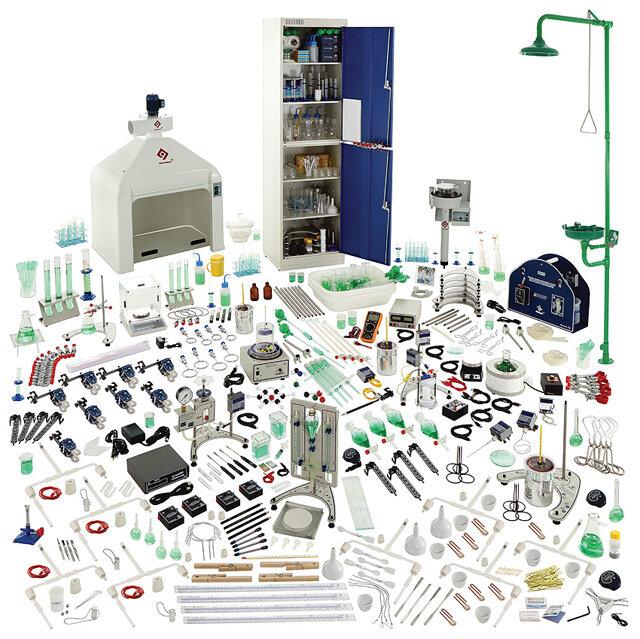
Set for chemistry with sensors, interface and safety items, for 4 groups
EQ351C
Function
Intended for experimental study, chemistry laboratory and carrying out chemistry experiments on: temperature measurements, filtration processes, magnetic separation, distillation, decantation, homogeneous and heterogeneous systems, density measurements, changes in physical states of water, conservation laws of matter, atomic structure, electrical conductivity, solubility of substances, types of chemical reactions, comparison between acids, bases, character of oxides and obtaining salts, pH studies, titrimetry, fruit concentration, water equivalent in calorimeter, specific heat of a solid, endothermic and exothermic reactions, heat of neutralization, electrochemical cells, concentration factor, temperature and catalyst in reactions, isothermal transformation, Boyle-Mariotte, influence of temperature on the atomic and molecular movement of a gas, concentrations of solutions, organic structures, identification of chemical elements in organic chains, hydrocarbon functions, alcohol, etc.
Areas of Knowledge
General chemistry, inorganic, physical chemistry, organic chemistry.
Main Experiments
-
Introduction to a Chemical Laboratory — 1201.003_0
-
General procedures for an experimental lesson FQB — 1201.003
-
Laboratory reports and notebooks FQB. — 1201.003C
-
— 1995.999A
-
Comparing different volume measurement scales. — 1032.003_B_1
-
— 1032.003_C_2
-
— 1032.003_B
-
How are the temperatures of a Bunsen burner measured? — 1201.011
-
How to identify homogenous and heterogeneous systems — 1201.010
-
How do you determine the density of a liquid using a pycnometer? — 1042.036_1
-
The determination of the density of a liquid by an aerometer — 1042.036_2
-
How do you determine the density of a solid? — 1042.036_3
-
— 1201.014_B_1
-
— 1201.014_B_2
-
Lavoisier and Proust's law, in a reaction chamber. — 1232.015
-
— 1212.012_1
-
— 1212.012_2
-
— 1212.012_3B
-
How to separate heterogeneous mixtures using decantation — 1212.012_4
-
— 1212.014_A_1
-
— 1212.014_B_2
-
How can we relate the properties of substances through electrical conductivity? — 1222.012_A_1
-
Chemical bonding – How to describe the properties of substances through solubility in polar and nonpolar solvents. Part II of II — 1222.012_2
-
How to identify the occurrence of a chemical reaction — 1232.002
-
Classification of inorganic reactions - How does the decomposition reaction analysis of sodium carbonate occur? Part I of IV — 1232.026_1
-
Classification of inorganic reactions - How does the reaction of synthesis of ammonium chloride occur? Part II of IV — 1232.026_2
-
How does the hydrogen displacement reaction, a single replacement reaction, occur? — 1232.027_1
-
How does a double displacement reaction occur? — 1232.027_2
-
Classification of inorganic reactions - How does the reaction of oxidation-reduction redox occur? — 1232.028
-
How do acids and bases behave in relation to different indicators? — 1252.024_1
-
Inorganic chemical functions – How to analyze the different chemical properties of acids. Part II of II — 1252.024_2
-
Inorganic chemical functions – How to identify the nature of an oxide. Part I of III — 1252.022_1
-
How do you identify the acidic nature of an oxide? — 1252.022_2
-
Inorganic chemical functions – How to obtain a basic oxide. Part III of III — 1252.022_3
-
Inorganic chemical functions – How to obtain salts — 1252.026
-
pH determination and limitations of indicator paper — 1272.008
-
Titration — 1272.002A
-
The concentration of acid in a fruit — 1272.004A
-
The water equivalent and heat capacity of a calorimeter. — 1052.027A
-
Determining the specific heat capacity of a solid. — 1052.003I
-
Endothermic reaction of copper sulfate with water. — 1232.016A
-
Exothermic chemical reaction of copper nitrate — 1232.016B
-
The heat of neutralization. — 1292.002A
-
Electrochemistry, the Daniell cell. — 1082.039
-
Electrolytes, second-class conductors. — 1242.002
-
The decomposition of water through electrolysis, variable source. — 1242.004_A
-
The concentration factor. — 1282.002
-
The temperature factor — 1282.004
-
The catalyst factor. — 1282.006
-
Study of gases - Isothermal transformation, Boyle-Mariotte´s Law - Sensor — 1052.032Q1
-
Influence of temperature on the atomic and molecular motion of a gas. — 1052.035Q
-
Concentration of solutions, both standard and ppm. — 1262.002
-
Concentration of solutions, molar, molarity. — 1262.004
-
Concentration of solutions, normal, normality. — 1262.006
-
Concentration of solutions, Title. — 1262.008
-
Concentration of solutions - Percentage by volume % v/v — 1262.010
-
How to use the insufflation bulb — 1201.004
-
Construction of three-dimensional organic structures. — 1302.001
-
Organic elemental analysis - Identification of carbon through the flame — 1302.002A
-
— 1302.002B1
-
— 1302.002C1
-
Organic elemental analysis - identification of nitrogen — 1302.004A
-
Organic elemental analysis - identification of halogen through the formation of a salt — 1302.004B
-
Organic elemental analysis - identification of halogen through the flame — 1302.004C
-
Organic elemental analysis - identification of oxygen — 1302.006A
-
Organic elemental analysis - identification of sulfur — 1302.006B
-
— 1302.008A
-
— 1302.010A
-
— 1302.012A1
-
— 1302.012B1
-
Aromatic hydrocarbons – solubility — 1302.014A
-
Aromatic hydrocarbons - combustion — 1302.014B
-
Aromatic hydrocarbons – alkylation reaction — 1302.014C
-
Alcohol, water absorption, color change. — 1302.016A
-
Organic functions, Alcohol – How to produce an oxidation reaction — 1302.016C
-
Some special precautions in the laboratory QB. — 1201.003B
-
— 1201.001
-
Procedures for conducting experiments QB. — 1201.003D
-
Some guidelines on cleaning and drying glassware QB. — 1201.005