
 Português
 English
 Español
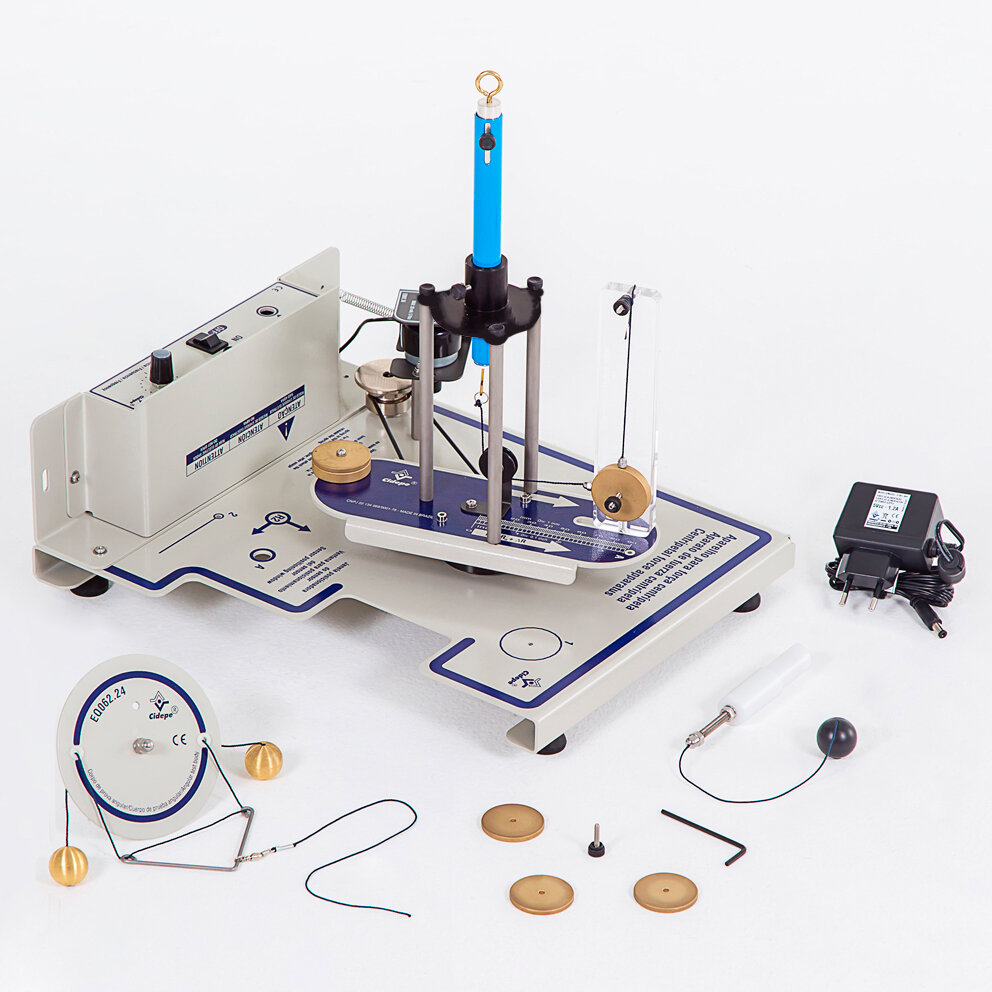
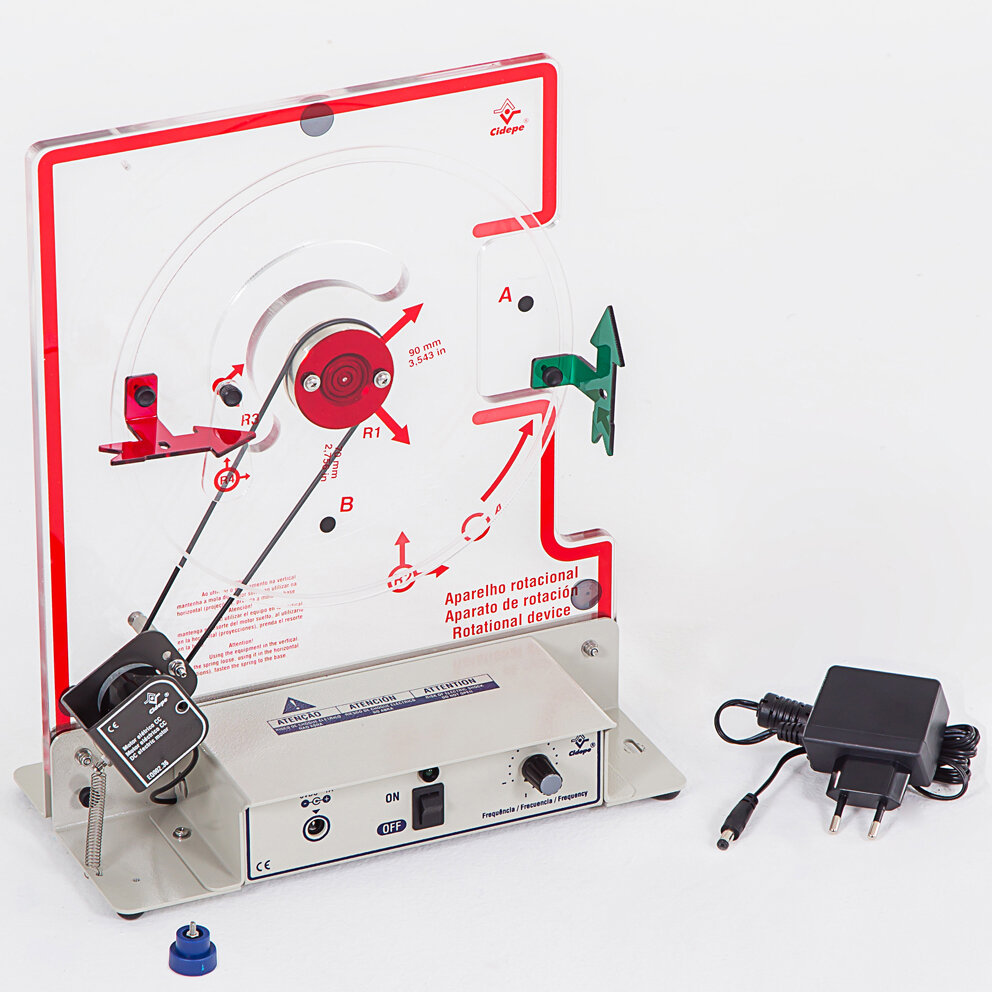
Projectable rotational apparatus with removable arrows and power supply
Code: EQ002M

Function
Intended for the study, physics laboratory, physics experiments on: Kinematics. The relativity of motion according to the reference frame. Motions according to the reference frame. Pure rotational motion and pure translational motion. Uniform circular motion (UCM). The period of circular motion. The unit of period. A technique to reduce timing error. Frequency and its relation to period. Calculation of tangential velocity as a function of period, calculation of tangential velocity as a function of frequency. The orientation of the tangential velocity vector and the orientation of the centripetal acceleration vector. Angular velocity. The relationship between tangential velocity and angular velocity. Transmission velocity from uniform circular motion. The combined motion of uniform rectilinear motion (URM) with UCM. Universal gravitation. Kepler's laws for planetary motion. Kepler's first law, the law of orbits. The ellipse. Kepler's second law, the law of areas. Determining the period of a planet's orbit. Kepler's third law, the law of periods. Wave motion. Simple harmonic motion (SHM) from uniform circular motion (UCM). The motion of the projection P of a body Q in UCM, on one of its axes. The motion seen looking at the disc from the front (UCM). The tangential velocity of body Q in UCM. The angular velocity of body Q in UCM. The SHM executed by the projection P of body Q in UCM on a screen perpendicular to the plane containing x and y. Parameters of the SHM of the projection P, measured on the screen. Relating the UCM executed by body Q to the SHM executed by its projection P. Relating the angular velocity of body Q (in UCM) to its angular frequency (SHM). The tangential velocity of body Q in UCM and the linear velocity of its projection P in SHM. The behavior of the elongation, velocity, and acceleration of the projection P in y, when body Q transits through different quadrants. The elongation, velocity, and acceleration of the projection P in SHM when body Q transits in UCM in the first quadrant. The elongation, velocity, and acceleration of the projection P in SHM when body Q transits in UCM in the second quadrant. The elongation, velocity, and acceleration of the projection P in SHM when body Q transits in UCM in the third quadrant. The elongation, velocity, and acceleration of the projection P in SHM when body Q transits in UCM in the fourth quadrant. Gravitation, Kepler's laws. The shape and direction of planetary orbits. The ecliptic. Kepler's first law, the law of orbits. The perigee and perihelion of the Earth. The apogee and aphelion of the Earth. The eccentricity of an ellipse. The eccentricity of the orbits of the planets in the solar system. The values of the perihelion and aphelion of the Earth. Kepler's second law, Kepler's law of areas. The areal velocity of a planet, etc.
Note: Photoelectric sensor and data acquisition system not included.
Quote product